You’re mid-conversation with a friend, and suddenly it hits you: I’ve done this exact moment before. Same words. Same room. Same weird feeling in your chest.
For a second, it feels less like memory and more like proof — proof that some part of your brain already knew this was coming.
It’s a strange, almost eerie sensation. And it’s raised a genuinely fascinating question in psychology and neuroscience: can your brain predict the future, or is something else going on entirely?
The honest answer is more interesting than a simple yes or no. Your brain isn’t psychic. But it is constantly making predictions, faster and more often than you’d ever guess. Understanding the difference between “predicting” and “seeing the future” is where this gets genuinely fascinating.
This topic is also covered in a quick video breakdown on the PsychCuts YouTube channel — but this article goes much deeper into the actual research.
Table of Contents
- What People Believe About “Feeling” the Future
- What Modern Neuroscience Actually Says
- The Science of Déjà Vu: A Predictive Brain Glitch
- Famous Studies That Tried to Prove Precognition
- Myth vs. Evidence: Separating Fact from Fiction
- Everyday Examples of Your Predictive Brain at Work
- Practical Takeaways
- Frequently Asked Questions
- Conclusion
- Key Takeaways
What People Believe About “Feeling” the Future
Ask around, and you’ll find no shortage of people who believe they’ve had a genuine glimpse of what’s coming. It usually falls into one of three categories.
Déjà Vu and the Feeling You’ve “Already Lived This”
This is the big one. Roughly two-thirds of people experience déjà vu at some point in their lives. It feels less like imagination and more like a memory replaying in real time.
Gut Instincts and “Knowing” Something Bad Is Coming
Plenty of people describe a sudden, unexplainable sense of dread right before something goes wrong — a phone call with bad news, a near-accident, a relationship ending.
Precognitive Dreams
Some people report dreaming about an event, then watching it seemingly play out days or weeks later, exactly as dreamed.
All three experiences are real. People genuinely feel them. The disagreement isn’t about whether the feeling happens — it’s about what’s actually causing it.
What Modern Neuroscience Actually Says
Here’s the part that surprises most people: neuroscientists generally agree your brain is constantly predicting the future. Just not in the way you’re imagining.
Your Brain Is a Prediction Machine (Not a Psychic One)
For a long time, scientists pictured the brain as a passive receiver. Light hits your eyes, sound hits your ears, and your brain simply processes what comes in, like a camera recording a scene.
That model has been overturned. A framework called predictive processing (sometimes called predictive coding) is now one of the most influential ideas in cognitive neuroscience. The theory traces back to 19th-century scientist Hermann von Helmholtz, and has been developed further by modern researchers like neuroscientist Karl Friston.
The idea works like this: your brain is constantly building a model of what it expects to happen next, based on everything you’ve experienced before. When new information comes in through your senses, your brain compares it to that prediction. If they match, you perceive the world smoothly. If they don’t match, your brain gets an “error signal” and quickly updates its model.
This isn’t a fringe theory. It’s used to explain everything from how you catch a ball without consciously calculating its trajectory, to how you can understand a sentence before someone finishes speaking it.
The Predictive Brain, Explained Simply
Think about walking down a staircase. You don’t consciously measure every step. Your brain predicted the height of each step based on the first one or two, and your legs move accordingly. If a step is unexpectedly higher or lower, you stumble — that’s a prediction error in real time.
Your brain does this constantly, for almost everything: conversations, movement, vision, even your own emotions. It’s less “seeing the future” and more like an incredibly fast, constantly-updating best guess.
Why This Feels Like “Predicting the Future” (But Isn’t)
This is the key distinction. Predicting the future in a psychic sense would mean your brain somehow accesses information that doesn’t exist yet.
Predictive processing is different. Your brain isn’t reaching into tomorrow — it’s using patterns from your past to make an educated guess about what’s most likely to happen in the next second, minute, or hour. It’s prediction based on probability, not perception of events that haven’t occurred.
That distinction matters, because it’s exactly what explains déjà vu.
The Science of Déjà Vu: A Predictive Brain Glitch
Déjà vu has been studied for well over a century, and researchers still don’t have one single, universally agreed-upon explanation. But several strong, evidence-based theories point in a similar direction.

Brain imaging research consistently shows heavy involvement from the temporal lobe and hippocampus — two regions central to memory and recognition — during déjà vu experiences.
One leading researcher in this area, neuroscientist Akira O’Connor at the University of St Andrews, describes déjà vu as a kind of internal fact-checking system. According to this view, part of your brain briefly signals “this feels familiar,” while another part checks that signal against your actual memories and finds no real match. The strange sensation of déjà vu is what happens in that split second of conflict.
Other researchers focus more directly on the predictive brain angle: your brain is constantly comparing the present moment to your stored patterns of experience. Déjà vu may happen when your brain’s predictive system briefly misfires, tagging a brand-new moment as something it has already seen before, even though it hasn’t.
Interestingly, some scientists have even recreated something like déjà vu in the lab, using virtual reality environments that are subtly similar to a scene a participant has seen before, without being identical. Many participants reported the familiar-but-wrong feeling of déjà vu under these conditions.
None of this points to psychic ability. It points to a brain that’s constantly predicting and checking itself, and occasionally getting its signals crossed.
Famous Studies That Tried to Prove Precognition
If any single study pushed the “can your brain predict the future” question into the mainstream, it’s this one.
Daryl Bem’s “Feeling the Future” (2011)
In 2011, respected social psychologist Daryl Bem published a set of nine experiments in a major psychology journal, arguing that people could sense future events before they happened. In one of the most talked-about versions of the study, participants seemed to show a slight preference for images before they were randomly selected to see them.
The results were statistically significant, and the paper was published in a well-regarded, peer-reviewed journal. It caused a genuine stir in the field, precisely because it followed normal scientific methods rather than fringe research practices.
What Happened When Other Scientists Tried to Replicate It
Then came the part science is actually built on: other researchers tried to repeat the experiments.
Multiple independent teams attempted to replicate Bem’s results. A set of pre-registered replication attempts published in 2012 found no significant evidence for the effect at all. A separate, large-scale analysis pooling data from thousands of participants across many replication attempts also found the overall effect was indistinguishable from zero.
In plain terms: when scientists repeated the exact same experiments, the “precognition” effect disappeared.
This doesn’t mean Bem was dishonest, or that the original study was fraudulent. It became something more useful than a scandal — a case study in why replication matters, and why one exciting result isn’t the same thing as proof. The episode is now widely cited as a turning point that pushed psychology toward more rigorous research standards.
Myth vs. Evidence: Separating Fact from Fiction
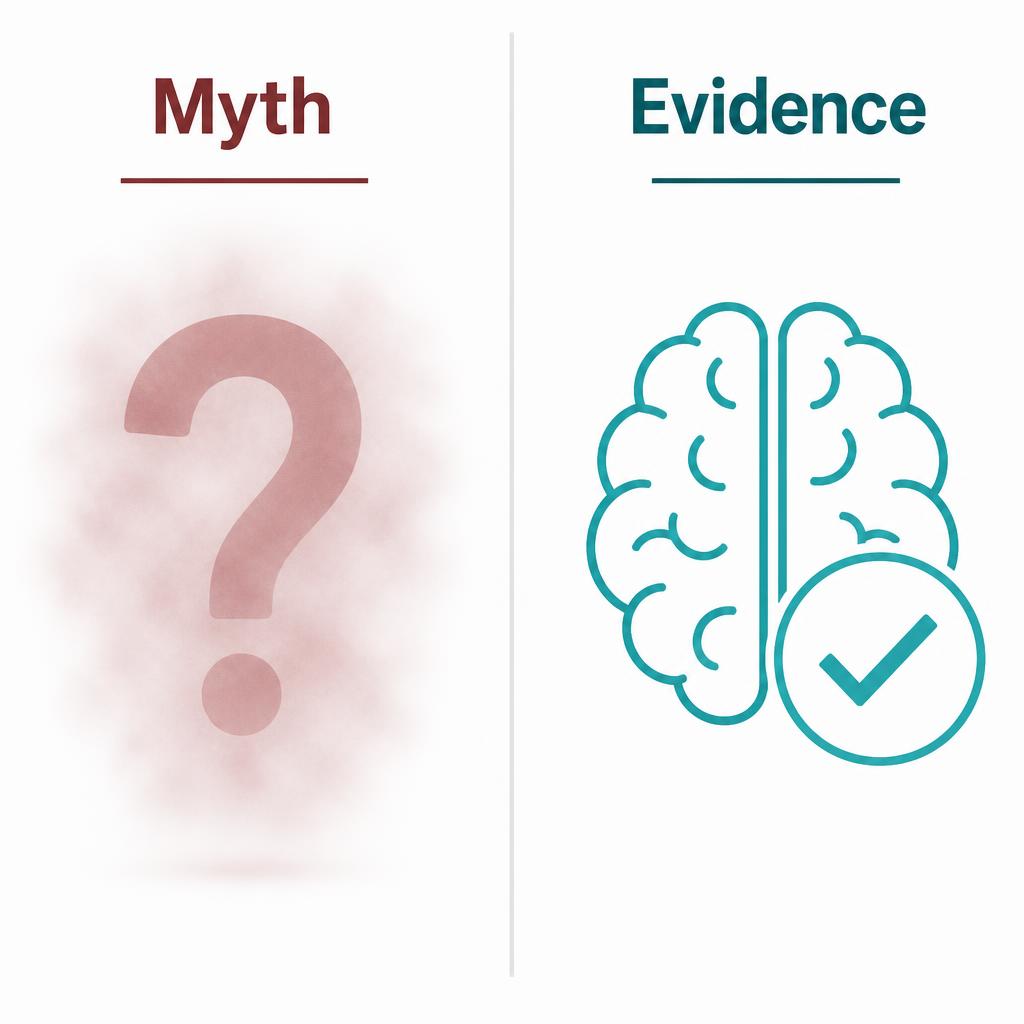
Here’s a simple breakdown of where the science actually lands.
Myth: Your brain can access information about events that haven’t happened yet. Evidence: No well-replicated study has ever demonstrated this. Precognition claims, including Bem’s famous study, have failed to hold up under repeated testing.
Myth: Déjà vu proves you’ve somehow “seen” this moment before, in a past life or a psychic sense. Evidence: Déjà vu is well-explained by memory and familiarity systems in the temporal lobe, without needing any supernatural explanation.
Myth: Your brain only reacts to the world after something happens. Evidence: This one’s actually backward. Predictive processing research shows your brain is constantly forecasting what’s about to happen, based on prior experience — this part is genuinely well-supported.
Myth: A strong gut feeling that “something is about to happen” is proof of a sixth sense. Evidence: More likely explanation: your brain has picked up on subtle patterns or cues (a tone of voice, a change in routine, body language) that you haven’t consciously registered, and it’s using them to generate a fast, subconscious prediction.
Everyday Examples of Your Predictive Brain at Work
You don’t need a lab to see predictive processing in action. It shows up constantly.
- Finishing someone’s sentence in your head before they say the last word
- Reaching for a light switch in a familiar room without looking
- Flinching before a loud noise you saw coming (a dropped glass, a car horn)
- Feeling “thrown off” when an elevator door opens on the wrong floor
- Anticipating a joke’s punchline halfway through, and laughing early
In every one of these moments, your brain built a prediction from past experience, then compared it against what actually happened. That’s the real, evidence-backed version of your brain “seeing the future” — just a few seconds at a time, based on probability, not psychic insight.
Practical Takeaways
- Your brain constantly predicts what’s about to happen, based on pattern recognition from past experience — this is well-established neuroscience, not speculation.
- Déjà vu is very likely a predictive or memory-checking glitch, not evidence of precognition.
- The most famous scientific claim of literal precognition (Bem’s 2011 study) failed to replicate in later, more rigorous testing.
- A strong gut feeling isn’t necessarily supernatural — it may be your brain picking up on real, subtle cues faster than you can consciously notice them.
- Understanding your brain as a “prediction engine” can help you make sense of everyday moments that otherwise feel unexplainable.
Frequently Asked Questions
Can your brain actually predict the future? Not in a literal, psychic sense. But your brain constantly predicts what’s likely to happen next based on patterns from your past experience. This is a well-supported area of neuroscience called predictive processing.
Is déjà vu proof of precognition? No well-replicated scientific evidence supports that idea. Most current research points to déjà vu being related to memory and familiarity processes in the brain’s temporal lobe.
What is predictive processing in simple terms? It’s the idea that your brain is constantly guessing what’s about to happen, based on experience, and then adjusting that guess when new information comes in. It’s often described as the brain acting more like a prediction engine than a passive camera.
Did scientists ever prove precognition is real? A widely publicized 2011 study claimed to find evidence of it, but subsequent attempts by other researchers to replicate the results failed to find the same effect.
Why do I sometimes get a strong feeling something bad is about to happen? This is often explained by your brain picking up on subtle environmental or behavioral cues below your conscious awareness, then generating a fast prediction that feels like intuition.
Is déjà vu a sign of a health problem? For most people, occasional déjà vu is completely normal and not a cause for concern. However, frequent or prolonged déjà vu-like experiences can sometimes be associated with certain neurological conditions, including some forms of epilepsy, so it’s worth mentioning to a doctor if it becomes frequent or unusual.
What part of the brain is responsible for déjà vu? Research points primarily to the temporal lobe and hippocampus, both heavily involved in memory formation, recognition, and familiarity judgments.
Can dreams actually predict future events? There’s no scientifically validated evidence that dreams can foresee specific future events. Apparent matches are generally better explained by coincidence, vague dream content that fits many situations, and selective memory (we tend to remember the “hits” and forget the many dreams that didn’t come true).
What is the difference between intuition and precognition? Intuition is generally understood as fast, subconscious pattern recognition based on real information you’ve already encountered. Precognition would require sensing information about events that haven’t happened yet — a claim that hasn’t held up to scientific testing.
Why did Daryl Bem’s study get so much attention if it wasn’t true? Because it was published using completely standard, respected scientific methods in a top psychology journal, rather than fringe research. That made its failure to replicate an important moment for the field, helping trigger broader reforms in how psychological research is conducted and verified.
Conclusion
Your brain isn’t seeing the future. It’s something almost more impressive: an organ that’s constantly running probability calculations, using a lifetime of stored experience, to guess what’s coming next, often correctly, often before you’re even aware it’s happening.
That’s why déjà vu feels so uncanny. Why a gut feeling can feel eerily accurate. Why you can finish a sentence before someone says it. None of it requires anything supernatural. It requires a brain that’s remarkably good at pattern recognition, running quietly in the background of every moment of your life.
The science of the predictive brain doesn’t make the experience any less fascinating. If anything, it makes it more so; you don’t need to believe in psychic powers to be amazed by what your mind is actually doing every single second.
Key Takeaways
- The brain doesn’t literally predict future events — it constantly forecasts what’s likely to happen next, based on past experience.
- This concept is called predictive processing, a leading framework in modern neuroscience.
- Déjà vu is best explained as a memory or predictive-system glitch, not genuine precognition.
- Daryl Bem’s famous 2011 “Feeling the Future” study failed to replicate in later, more rigorous experiments.
- Strong gut feelings are often your brain detecting subtle real-world cues you haven’t consciously noticed yet.
- None of this diminishes how remarkable the brain actually is — it just replaces the supernatural explanation with an equally fascinating scientific one.