Why do we forget names even when we instantly recognize someone’s face?
You know the face instantly. You could describe their laugh, where you met, what they were wearing last time. And then someone asks their name, and your mind goes completely blank.
It happens to almost everyone, constantly. It feels like proof that names are simply harder to remember than faces.
Here’s the twist: that assumption is backwards. Research suggests your brain is actually better at remembering names than faces. The real explanation for why this feels so wrong is far more interesting than “bad memory.”
Interested in how the brain makes predictions? Read our article on Can Your Brain Predict the Future? What Science Says.
Table of Contents
- What Most People Believe About Names and Faces
- The Study That Flipped the Assumption
- Why Do We Forget Names Even Though We Recognize Faces?
- Recall vs. Recognition: The Real Difference
- Why Names Specifically Are Vulnerable
- Myth vs. Evidence
- Practical Ways to Remember Names Better
- Frequently Asked Questions
- Conclusion
- Key Takeaways
Why Do We Forget Names? What Most People Believe
Ask almost anyone, and you’ll hear some version of the same complaint: “I’m terrible with names, but I never forget a face.” It’s such a common experience that it’s become a cultural cliché — even Groucho Marx built a joke around it decades ago.
The assumption baked into that complaint is simple: faces are easy to remember, names are hard. It feels obviously true, because the failure (forgetting a name) happens constantly, while success (recognizing a face) feels effortless and invisible.
Why Do We Forget Names? The Study That Changed Everything
In 2018, researchers at the University of York set out to test this assumption directly and fairly. Most memory research up to that point had a built-in bias: studies typically tested face memory using recognition tasks (seeing a face again and identifying it) while testing name memory using recall tasks (producing the name from scratch, with no options given). That’s not a fair comparison — recall is a much harder mental task than recognition, regardless of what’s being remembered.
So the researchers redesigned the test to compare names and faces using the exact same method: recognition. Participants were shown unfamiliar names and unfamiliar faces, then tested later on which ones they’d seen before.
The result surprised even the researchers. Names were recognized more accurately than faces, across all three experiments. In one version of the test, participants recognized as little as 64% of faces, compared to up to 83% of names.
Why It Feels Like the Opposite Is True
If names are genuinely easier to recognize, why does forgetting a name feel like such a universal, constant failure?
The researchers point to something subtle but important: you only become consciously aware that you’ve forgotten a name after you’ve already recognized the face. The face recognition happens instantly and automatically — you don’t notice it as an achievement, because it doesn’t feel like effort. The name failure, on the other hand, is loud, awkward, and immediate.
In other words, you’re comparing a silent success to a noisy failure, and concluding the wrong one is harder.
Recall vs. Recognition: The Real Difference
This is the actual mechanism worth understanding, and it applies far beyond just names and faces.
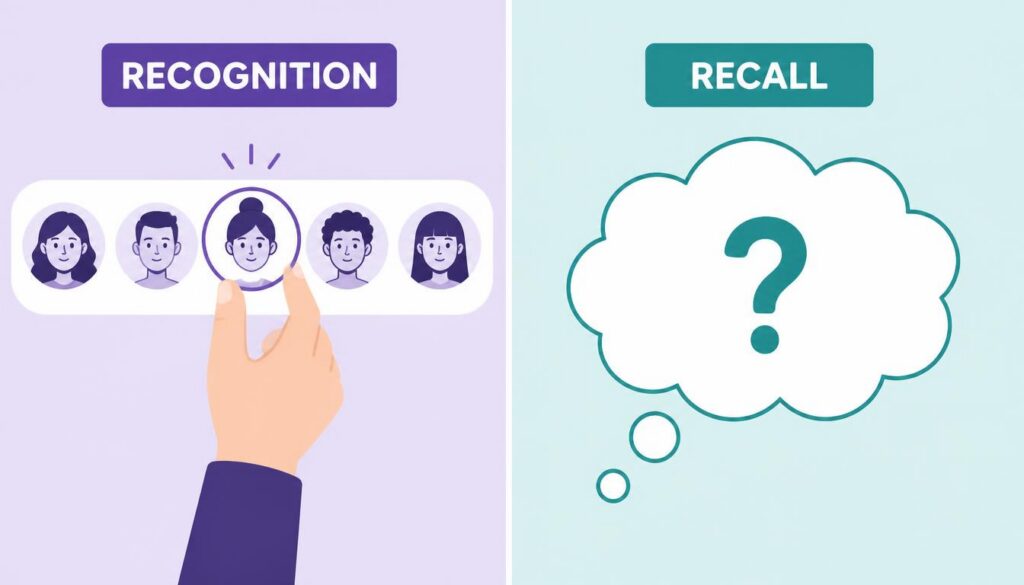
Recognition means being shown something and deciding whether you’ve encountered it before. It comes with built-in cues — the actual stimulus is right in front of you, prompting your memory.
Recall means producing information from memory with little or no prompt. When someone’s face triggers a vague sense of familiarity but you have to produce their name entirely from your own head, you’re relying on recall, the much harder of the two processes.
This is why forgetting names feels so specifically frustrating: you’re not failing at memory in general, you’re failing at the harder version of a memory task, in a moment when the easier version (recognizing the face) has just succeeded and made the gap obvious.
Why Names Specifically Are Vulnerable
Even accounting for the recall/recognition difference, names do have a real disadvantage worth understanding.
Faces are information-rich. A face simultaneously communicates age, gender, mood, distinctive features, and dozens of small visual details your brain can hook memory onto. Researchers describe faces as an unusually rich stimulus for memory to grab onto.
Names are arbitrary. A name is just a short sequence of sounds with no inherent connection to the person carrying it. There’s no logical reason “Michael” belongs to a particular face — it’s an arbitrary label, and arbitrary information is notoriously harder for the brain to anchor than something meaningful or visually distinctive.
Names are also extremely common. Common names in particular carry little unique information — you likely know several Sarahs, Davids, or Emilys, meaning a specific name doesn’t map cleanly onto one specific memory the way a unique face does.
Myth vs. Evidence
Myth: People are naturally worse at remembering names than faces. Evidence: When tested fairly (recognition vs. recognition), names are actually recognized more accurately than faces.
Myth: Forgetting someone’s name means you weren’t paying attention or don’t care about them. Evidence: Name-forgetting is a structural feature of how recall works, not a measure of attentiveness or interest — it happens to highly attentive, socially engaged people constantly.
Myth: If you’re “bad with names,” it’s a fixed personal trait. Evidence: Since the underlying issue is usually the recall-vs-recognition gap and the arbitrary nature of names, specific memory techniques (below) can meaningfully improve name recall for almost anyone.
Practical Ways to Actually Remember Names
Since the core problem is recall, not general memory weakness, the fix is to convert the task into something closer to recognition or association.
- Repeat the name immediately (“Nice to meet you, Sarah”) — this forces active encoding instead of passive hearing
- Create a deliberate association between the name and a distinctive feature of the face or a mental image, even an odd one
- Use the name again within the conversation — each repetition strengthens retrieval pathways
- Don’t panic-search silently — if you’ve forgotten, asking again directly is more effective (and far less awkward) than most people assume
Frequently Asked Questions
Why do I forget names but remember faces so easily? Faces are recognized automatically and effortlessly, while names typically require harder recall. Research suggests names are actually recognized more accurately than faces when tested fairly — the difference is in how each memory task works, not raw memorability.
Is forgetting names a sign of a memory problem? For most people, occasional name-forgetting is completely normal and reflects the recall-vs-recognition gap, not a memory disorder. If it’s happening alongside other significant memory changes, that’s worth discussing with a doctor, but on its own it’s an extremely common, non-concerning experience.
Why are some names harder to remember than others? Unusual or distinctive names are often easier to recall because they stand out; common names carry less unique information and are more easily confused with other people you know by the same name.
Does this get worse with age? Name recall does tend to become somewhat more effortful with age for many people, but the underlying recall-vs-recognition mechanism is present at every age — it’s not purely an aging phenomenon.
Can you actually train yourself to be better with names? Yes. Techniques that convert recall into association or repetition (like immediately repeating a name back, or linking it to a visual detail) have real, demonstrated effectiveness, because they work with how memory actually functions rather than against it.
Why does it feel so much more embarrassing to forget a name than to forget other information? Names are tied directly to a person’s identity and social recognition, so forgetting one carries social weight that forgetting, say, a phone number doesn’t. That social cost makes the failure memorable and embarrassing, even though the underlying memory mechanism isn’t unusual.
Is it true that we only have dedicated brain “wiring” for faces, not names? The brain does have specialized regions particularly active in facial recognition, giving faces a processing advantage in certain respects. This contributes to why face recognition feels automatic, but it doesn’t mean names are inherently harder to store in memory overall.
Does caring more about someone help you remember their name better? Attention and motivation can help, but they don’t eliminate the structural recall challenge. Plenty of people forget the names of people they deeply care about, simply because of how recall works — it isn’t a reliable measure of how much someone matters to you.
Conclusion
If you’ve ever wondered why do we forget names, the answer isn’t that you have a bad memory. It’s proof of a very specific, well-understood gap between two different memory processes — recognition, which is fast, effortless, and usually successful, and recall, which is slow, effortful, and prone to failure, especially for something as arbitrary as a name.
Once you see the mechanism, the whole experience stops feeling like a personal flaw and starts looking like exactly what it is: a completely ordinary, predictable feature of how memory works for everyone.
Key Takeaways
- Research suggests names are actually recognized more accurately than faces when tested under fair conditions.
- The real issue isn’t “names vs. faces” — it’s recall (hard) vs. recognition (easy), and names typically require recall.
- Names are arbitrary labels with no inherent connection to a person, making them harder to anchor in memory than visually rich faces.
- Forgetting a name isn’t a sign of poor attention, low memory ability, or not caring about someone.
- Specific techniques (repetition, association, using the name in conversation) genuinely improve name recall because they work with how memory functions.
1 thought on “Why Do We Forget Names? 7 Psychology Facts Explained”